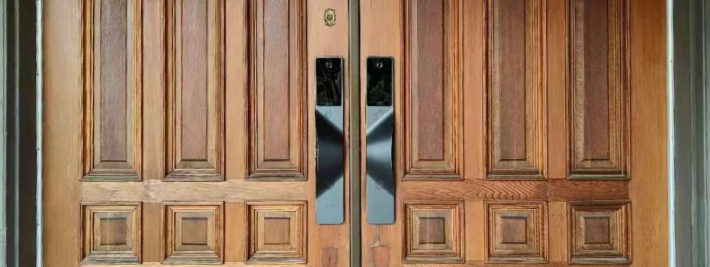


Almost every article answering how secure is a smart lock spends its length on hacking: encryption, app vulnerabilities, whether a thief with a laptop can talk their way through your door remotely. That is a real question. It is not the question that matters most for how a door actually gets broken into. The far more common failure is force applied directly to the door, not a signal intercepted from a parking lot. This article covers both, honestly, starting with the one that gets asked less but matters more.

Why Forced Entry is the Risk that Actually Matters
Break-ins overwhelmingly happen by force: a kick, a pry bar against the door near the lock, a shoulder against a weak frame, not a laptop running an exploit against a Bluetooth stack from the street. A lock's real security question is not only "can this be hacked," it is "what happens when someone tries to force this door open," and that second question is decided by mechanics, not software.
This is where fit and installation matter more than the brand on the box. A bolt-on smart lock clamps over an existing cylindrical bore and turns the bolt already installed in the door, depending on hardware often chosen for the builder's budget rather than security. A smart mortise lock is a different mechanical proposition: a larger, more substantial lock body sits inside a pocket cut into the door itself and engages the frame through a correctly fitted strike. A single-bolt deadbolt gives force a single point to concentrate on. A Lockin smart mortise lock throws multiple bolts into multiple locking points at once, spreading that force across more of the frame rather than one narrow strike. Neither format is automatically immune to forced entry, and a mortise lock fitted into a door without enough stile width to support it, or paired with a poorly set strike, is not doing its job regardless of how many bolts it has. What decides the outcome is whether the door, the lock, and the strike were matched and fitted correctly, and a multi-point mortise body gives that correct fit more to work with than a single bolt ever can.
None of this means every mortise lock resists force better than every deadbolt on a bad installation. It means correct fit and installation, not the lock format alone, is the part of the security conversation almost no article about smart lock hacking mentions at all. Forced entry is also not the only physical risk. Lock-picking, bumping, and drilling target the cylinder itself, on any lock format, a separate consideration worth asking about directly when choosing hardware. A traditional mechanical mortise lock stops there: once the bolts are thrown, it has no way of telling anyone that someone tried to force it. A Lockin smart mortise lock adds a built-in alarm and real-time detection of door and lock status on top of the same mechanical strength, so an attempted forced entry, or a door left unlatched, does not go unnoticed the way it would on a purely mechanical lock.

Does Correct Installation Matter More Than the Lock Itself?
Yes, and this is the uncomfortable answer most retailers skip because it is not something they control once the box ships. A mortise lock fitted with a misaligned strike, or screws too short to reach the framing, does not throw and catch as designed, regardless of how strong the lock body is. Long strike screws into solid framing matter on any lock, but a mortise body adds more that can go wrong: the pocket has to be cut to the correct depth in a stile wide enough to hold it without weakening the door, and the cross-bores have to be clean and properly aligned. The lock can be excellent and the installation can still be the weak point.
What About Hacking, Honestly
Hacking a smart lock is a real category of risk, and dismissing it entirely would be as dishonest as the articles that talk about nothing else. The realistic version of that risk looks less like a movie scene and more like weak or reused account passwords, a lock left on outdated firmware, or a temporary access code that was never revoked after a contractor or guest no longer needed it. Those are the actual points of failure in the software layer, largely under the owner's control.
A much smaller practical risk than the search volume around it suggests is a remote attacker defeating the lock's own encryption with no physical access. It happens in security research demonstrations. It is not the typical way homes are actually broken into, which is why leading with it, as most competitor content does, answers the search term while missing the point of the search.
What Happens to a Smart Lock When the Power Goes Out
A lock that only works with power is not a lock, it is a liability during an outage. A smart mortise lock retains a manual mechanical override, meaning the physical mechanism still throws and catches without electronics, and most designs also allow a physical key as a backup alongside the electronic ones. On a Lockin lock, there is a third option beyond the mechanical key: a Type-C port lets you power the lock temporarily from the outside using a standard portable power bank, so a dead battery on a doorstep does not mean waiting for a locksmith. Battery levels are a genuine maintenance point rather than a design flaw: a smart lock that warns before it runs out of power and can be recharged, temporarily powered externally, or have batteries replaced without removing it from the door is doing what it is supposed to do. The honest failure case is not "the lock stops working," it is "the owner ignored a low battery warning," a maintenance issue, not a security one.
Where the Real Risk Actually Sits
Put plainly: for most homes, the door failing under direct force is more likely than the lock failing under a remote digital attack. A correctly fitted lock, mortise or otherwise, on a solid door with a properly set strike is doing the mechanical half of the job. The software half, encryption, access logs, revocable codes, and timely firmware updates, is separate and just as necessary. A lock with excellent digital security but a hollow-core door and a weak strike is not secure. A lock with a strong mechanical fit and unpatched firmware is not secure either. Real security is both handled properly, not one traded for the other.

Questions People Ask About Smart Lock Security
Are smart locks secure?A correctly fitted smart lock resists forced entry well, and a mortise format gives it a more substantial mechanical connection to the door and frame than a bolt-on unit, but fit and installation decide the outcome more than the format on the box. A Lockin smart mortise lock adds multiple locking bolts and points beyond a single-bolt deadbolt, plus a built-in alarm and real-time status detection that a traditional mechanical mortise lock does not have. Its software layer carries a separate set of risks, mainly weak passwords, unpatched firmware, and unrevoked access codes, managed by the owner rather than being flaws in the hardware itself.
Can smart locks be hacked?In principle, yes, as can any connected device. In practice, the far more common point of failure is a weak or reused account password or a temporary code that was never revoked, not a remote attacker defeating the lock's encryption from outside the property. This is a real risk to manage, not the primary way homes are broken into.
Can a smart lock be picked or drilled like a regular lock?The cylinder itself, the part a key or code turns, is a separate consideration from how the lock body is mounted in the door, and it applies to any lock format. Pick resistance and drill resistance come down to the specific cylinder hardware used, which is worth asking about directly rather than assuming a mortise body alone makes a lock harder to defeat mechanically.
What happens to a smart lock during a power outage?The mechanical override still functions without electricity, and most smart mortise locks also allow a physical key as a backup. Some, including Lockin locks, add a Type-C port so the lock can be powered temporarily from the outside with a portable power bank. A depleted battery is a maintenance issue that modern locks warn about in advance, not a point where the door is left unsecured.
What this Means When You Are Choosing a Lock
Ask about the structural side before the software side. How is the lock fitted into the door. What happens to the strike and the frame. Whether the mechanical components meet recognized industry testing standards, such as ANSI/BHMA grading, is worth asking directly rather than assuming from the price tag. Does it retain a mechanical backup if the power or the electronics fail. Then ask about the software side: whether the encryption follows a standard protocol rather than something proprietary and unverified, how access is managed, whether codes can be revoked individually, whether firmware updates automatically. A lock that can answer both sets of questions is doing the job. One that only has a good answer for the second is only half secure.
BTRtec is the official North American distributor of Lockin smart mortise locks and fits every one it sells on houses in twelve cities across Canada and the United States, with the pocket, cross-bores, and strike fitted to the specific door rather than treated as a generic swap. For the technical difference between a mortise lock and a standard deadbolt, our guide on mortise locks versus deadbolts covers how each is built. For what correct installation actually involves, see our page on professional smart lock installation.
See the range of premium smart mortise locks, then check whether your door qualifies for installation included in the price. There is no pressure to buy, and if your door is not a fit, you will know before you spend anything.
CHECK IF YOUR DOOR QUALIFIES